Who Am I?
I believe there is a profound mystery and wonder to life that we often take for granted in the daily hustle and bustle of our own lives. In my practice as a counsellor, supervisor, and end-of-life doula, I repeatedly observe how, when we slow down and ground ourselves with a gentle self-awareness, we can provide the skillful means to develop a better understanding of the causes of our suffering and a greater ability to choose how we respond to the circumstances we experience in life.
I have a Certificate in Humanistic and Psychodynamic Counselling (Goldsmiths, University of London), a BACP accredited Diploma in Counselling (The Gestalt Centre, London) and a UKCP approved Diploma in Contemplative Supervision (The Karuna Insitute, Dartmoor). I continue to undertake CPD and have completed a Core Process Psychotherapy Diploma in Relational Mindfulness (The Karuna Institute), a Diploma in Jungian Psychology (Jung Centre, Dublin), a Certificate in A Person-Centred Approach to Death and Dying (Living Well Dying Well), a Gestalt Awareness Practice open-seat intensive with Esalen elder, Christine Price (Tribal Ground), Somatic Experiencing workshops with leading trauma pioneer, Peter Levine (Somatic Experiencing), Trauma Constellation workshops with gestalt and psychotrauma therapist, Vivian Broughton, Hakomi Practitioner Training (Hakomi London), practice and study of a number of Body Based Therapies and Martial Arts including Alexander Lowen's Bioenergetics, Hun Yuan Qi Gong (Institute of Contemporary Qi Gong), Bagua Zhang (Wu Tang Physical Culture Association), Pahlavani, Kalarippayat (Kalarippayat Academy UK), and Feldenkrais. I spent a decade travelling to the wilderness of Dartmoor and immersing myself in the teachings of Maura Sills, my core teacher and the founder of Core Process Psychotherapy. In addition, over a six year period, I completed a series of vision quests on Dartmoor (Wild&Home, School of Myth) and North Wales (David Wendl-Berry). Most recently, I have reimmersed myself in the work of C.G. Jung, the experiential writings of his Red Book, and the technique of Active Imagination he pioneered and drew upon in the gestation of that book as an alchemical means to transmute unconscious content into consciousness. I have a longstanding embodied mindfulness practice which has evolved over 30 years and an appreciation of various traditional transpersonal teachings.
I have a Certificate in Humanistic and Psychodynamic Counselling (Goldsmiths, University of London), a BACP accredited Diploma in Counselling (The Gestalt Centre, London) and a UKCP approved Diploma in Contemplative Supervision (The Karuna Insitute, Dartmoor). I continue to undertake CPD and have completed a Core Process Psychotherapy Diploma in Relational Mindfulness (The Karuna Institute), a Diploma in Jungian Psychology (Jung Centre, Dublin), a Certificate in A Person-Centred Approach to Death and Dying (Living Well Dying Well), a Gestalt Awareness Practice open-seat intensive with Esalen elder, Christine Price (Tribal Ground), Somatic Experiencing workshops with leading trauma pioneer, Peter Levine (Somatic Experiencing), Trauma Constellation workshops with gestalt and psychotrauma therapist, Vivian Broughton, Hakomi Practitioner Training (Hakomi London), practice and study of a number of Body Based Therapies and Martial Arts including Alexander Lowen's Bioenergetics, Hun Yuan Qi Gong (Institute of Contemporary Qi Gong), Bagua Zhang (Wu Tang Physical Culture Association), Pahlavani, Kalarippayat (Kalarippayat Academy UK), and Feldenkrais. I spent a decade travelling to the wilderness of Dartmoor and immersing myself in the teachings of Maura Sills, my core teacher and the founder of Core Process Psychotherapy. In addition, over a six year period, I completed a series of vision quests on Dartmoor (Wild&Home, School of Myth) and North Wales (David Wendl-Berry). Most recently, I have reimmersed myself in the work of C.G. Jung, the experiential writings of his Red Book, and the technique of Active Imagination he pioneered and drew upon in the gestation of that book as an alchemical means to transmute unconscious content into consciousness. I have a longstanding embodied mindfulness practice which has evolved over 30 years and an appreciation of various traditional transpersonal teachings.
I have a regular outdoor practice in my local park which is an integral part of my life. I notice that there is both the desire to move my body in the manner I have been taught as well as the awareness to sense how my body actually wants to move in the here-and-now. I spent decades learning various forms, practices and exercises only to then undergo a process of deep unlearning that has allowed a sensory tuning in to how my body uniquely needs and wants to move in any given moment.
Reading Iain McGilchrist's work on the divided brain and hemipshere theory has given me the words to make sense of this bilateral experience. When I go for a early morning run in the winter darkness with a head torch to guide me, I can observe the relationship between the wide, peripheral awareness of the right hemisphere calmy observing the bigger picture of what is being sensed in the present moment as well as the acute and jumpy focus of the left hemishpere ready to cut in and react in an instant if needed.
What I have learnt in studying different therapeutic modalities is that there is no one theory or practice that is complete in and of itself. Core Process Psychotherapy is heart-centred. Jungian Practice provides depth shadow work; an embracing of the shadowy line dividing good and evil that runs through the heart of every human being. Gestalt therapy offers an embodied, experiential and playful approach. The different modalities compliment each other and taken as a whole can provide a greater depth of therapeutic holding.
Emily Wilson's recent translation of Homer's The Odyssey begins with the line: 'Tell me of a complicated man.' and I see the twists and turns of Odysseus and his drawn out journey to return home after the spoils of the Trojan War echo our multifaceted human nature. My approach to therapy is imbued with a deep, creative sense of curiosity to be with all of who we are; the good, the messy, and whatever else may be present. Let us marvel in our complexity and difference.
My practice as a mindfulness-based gestalt therapist is founded on the neuro-psychology of philosophy as a means to enquire into the gestalt maxim that the whole is greater than the sum of the parts. The focus is to bring an awareness to what is figural for us in the moment as well as to maintain a phenomenological attunement to what is occuring in our wider field of awareness. This requires us to intentionally and attentively dwell simultaneously in both the acute focus of loci offered by the neural processing of the left hemisphere of the brain alongside the more expansive awareness provided by that of the right. As we embody this mindful practice, paying attention in the here-and-now, we reach a more fluid state of homeostasis and wellbeing.
I hold an honours degree in Modern Arts (Kingston University) and bring an experiential creativity to my counselling practice. This essentially grew from the building blocks of the Philosophies of Nature and History of Ideas modules that were core to my learning, most especially the play between the values and ideals of the Age of Enlightenment and Romanticism that deeply mirror our neurology.
I have previously tutored 8-week group courses in Embodied Mindfulness and Mindful Compassion (Centre for Better Health, Hackney), centred upon cultivating a healing compassion towards ourselves and others. I have had articles published in Therapy Today and The Journal of the Blake Society. During Covid, I wrote Stepping Through the Outdoors of Perception, a personal reflection of my experiences over the past decade working outdoors in London.
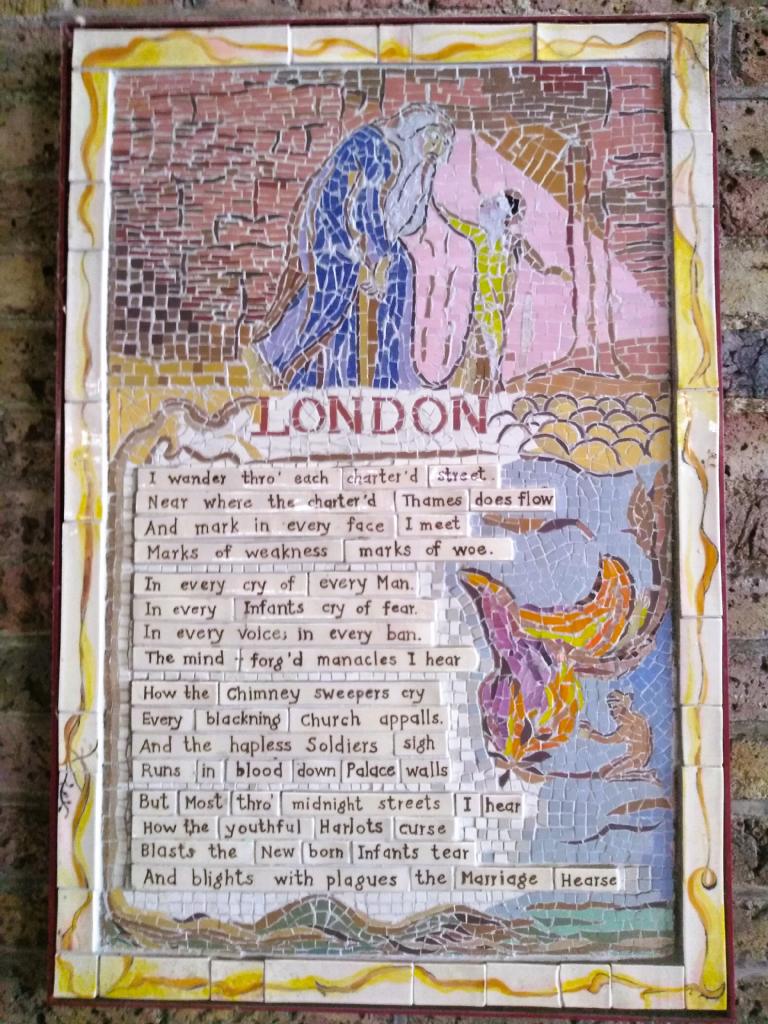
Songs of Innocence, Songs of Experience and Songs of Awakening
The artist William Blake and the founder of analytical psychology, C. G. Jung, are both big creative inspirations for how I work as a counsellor. I hold three principal aspects of myself in my counselling in a flat, rather than the more typically hierarchical, psychological structure giving each an equal weighting:
I find this balanced, holistic approach enables me to be more present relationally with all that is brought into a counselling session. We are equal partners in the relational work. As David Bowie sang, 'As long as there's me, As long as there's you'.
Reading Iain McGilchrist's work on the divided brain and hemipshere theory has given me the words to make sense of this bilateral experience. When I go for a early morning run in the winter darkness with a head torch to guide me, I can observe the relationship between the wide, peripheral awareness of the right hemisphere calmy observing the bigger picture of what is being sensed in the present moment as well as the acute and jumpy focus of the left hemishpere ready to cut in and react in an instant if needed.
What I have learnt in studying different therapeutic modalities is that there is no one theory or practice that is complete in and of itself. Core Process Psychotherapy is heart-centred. Jungian Practice provides depth shadow work; an embracing of the shadowy line dividing good and evil that runs through the heart of every human being. Gestalt therapy offers an embodied, experiential and playful approach. The different modalities compliment each other and taken as a whole can provide a greater depth of therapeutic holding.
Emily Wilson's recent translation of Homer's The Odyssey begins with the line: 'Tell me of a complicated man.' and I see the twists and turns of Odysseus and his drawn out journey to return home after the spoils of the Trojan War echo our multifaceted human nature. My approach to therapy is imbued with a deep, creative sense of curiosity to be with all of who we are; the good, the messy, and whatever else may be present. Let us marvel in our complexity and difference.
My practice as a mindfulness-based gestalt therapist is founded on the neuro-psychology of philosophy as a means to enquire into the gestalt maxim that the whole is greater than the sum of the parts. The focus is to bring an awareness to what is figural for us in the moment as well as to maintain a phenomenological attunement to what is occuring in our wider field of awareness. This requires us to intentionally and attentively dwell simultaneously in both the acute focus of loci offered by the neural processing of the left hemisphere of the brain alongside the more expansive awareness provided by that of the right. As we embody this mindful practice, paying attention in the here-and-now, we reach a more fluid state of homeostasis and wellbeing.
I hold an honours degree in Modern Arts (Kingston University) and bring an experiential creativity to my counselling practice. This essentially grew from the building blocks of the Philosophies of Nature and History of Ideas modules that were core to my learning, most especially the play between the values and ideals of the Age of Enlightenment and Romanticism that deeply mirror our neurology.
I have previously tutored 8-week group courses in Embodied Mindfulness and Mindful Compassion (Centre for Better Health, Hackney), centred upon cultivating a healing compassion towards ourselves and others. I have had articles published in Therapy Today and The Journal of the Blake Society. During Covid, I wrote Stepping Through the Outdoors of Perception, a personal reflection of my experiences over the past decade working outdoors in London.
Songs of Innocence, Songs of Experience and Songs of Awakening
The artist William Blake and the founder of analytical psychology, C. G. Jung, are both big creative inspirations for how I work as a counsellor. I hold three principal aspects of myself in my counselling in a flat, rather than the more typically hierarchical, psychological structure giving each an equal weighting:
- the 'young' aspect of myself that is like a soft piece of clay, malleable, porous, sensitive, that absorbs emotional energy, is prone to mask, can fragment, becomes overwhelmed easily, quickly dysregulates, and yearns to be met by an external source
- the 'adult' aspect of myself that is skilled, resourced, reflective, able to hold uncertainty and provide clear boundaries, is relationally adept, but can also revert to masking and often desires to be met externally by another
- the 'awakened' aspect of myself that pays attention and remembers it is internally met and received at all times by an unconditioned source (my soul) and is in awe of the centred sense of aliveness, potency, completion, ignition, joy and wholeness this internal connection brings
I find this balanced, holistic approach enables me to be more present relationally with all that is brought into a counselling session. We are equal partners in the relational work. As David Bowie sang, 'As long as there's me, As long as there's you'.